Yu Cheng-Yao, born in Fujian in 1898, spent his youth in the military, serving for over twenty years until the end of the Second Sino-Japanese War. After retiring, he moved to Taiwan in 1949 and lived a life of quiet seclusion in Taipei, entertaining himself with poetry, calligraphy, painting, and Nanguan music. He did not begin painting until 1954, and it was not until 1986, at the age of 88, that he held his first solo exhibition, instantly gaining widespread acclaim for his remarkable creative energy.
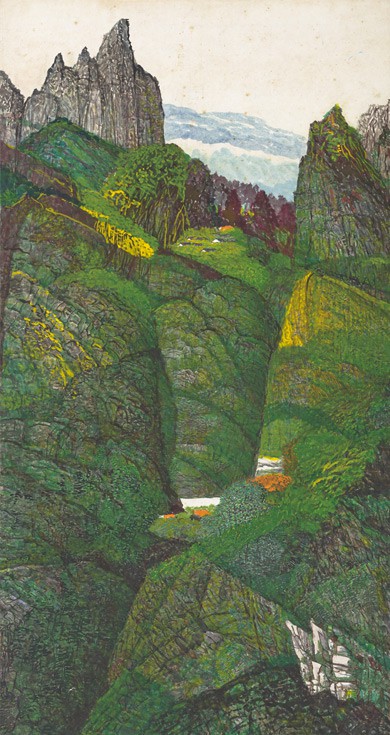
Within the tradition of Chinese landscape painting, a literati aesthetic had dominated since the early Song dynasty, characterized by softness, ethereal qualities, and a subtle, almost pale palette that defined centuries of scholarly painting. Yu Cheng-Yao, however, forged a unique path within this tradition. His works are distinguished by robust forms, bold compositions, vibrant colors, dramatic layouts, and an unyielding internal tension. This boldness evokes comparisons to Fan Kuan’s Travelers Among Mountains and Streams, where majestic forms and sweeping grandeur open new vistas in landscape art.
The featured work in this exhibition, “Landscape,” exemplifies Yu Cheng-Yao’s distinctive style. Towering mountains rise to the top of the canvas, leaving only a narrow strip of sky. Lush green and bright yellow foliage blankets the peaks, while a vivid stream winds diagonally from the lower left, intersecting with orange-hued trees and scattered houses. The painting balances dense, layered textures with open spaces, combining strength with spaciousness, solidity with fluidity, creating a scene both commanding and invigorating.
Yu Cheng-Yao single-handedly transcended the subtlety and restraint of traditional literati landscapes, injecting robust energy and vitality into Taiwanese and Chinese art. His works are not mere depictions of nature; they embody life force and spiritual resilience, showcasing the astonishing creative power of a “late-blooming” artist at the height of his artistic expression.