“Asianness” is a concept incessantly evolving through historical, geographical, and cultural changes, emerged from a variety of differences—multiple ethnicities, languages, cultures, religions, and historical experiences interwoven for Asia to remain in the state that is open, flowing, and rich in locality.
From the ancient migrations of humanity and other species to the trade networks and cultural exchanges setting sail in the Age of Discovery, and to the restructuring of institutions and identities brought by modern colonial experiences, Asia has been shaping itself in constant contact, collision, and transformation. In the contemporary context, globalization brings forth rapid urbanization, ecological crises and identity issues. Hence, re-articulating and revisiting “Asianness” serves as one of the very responses to globalization.
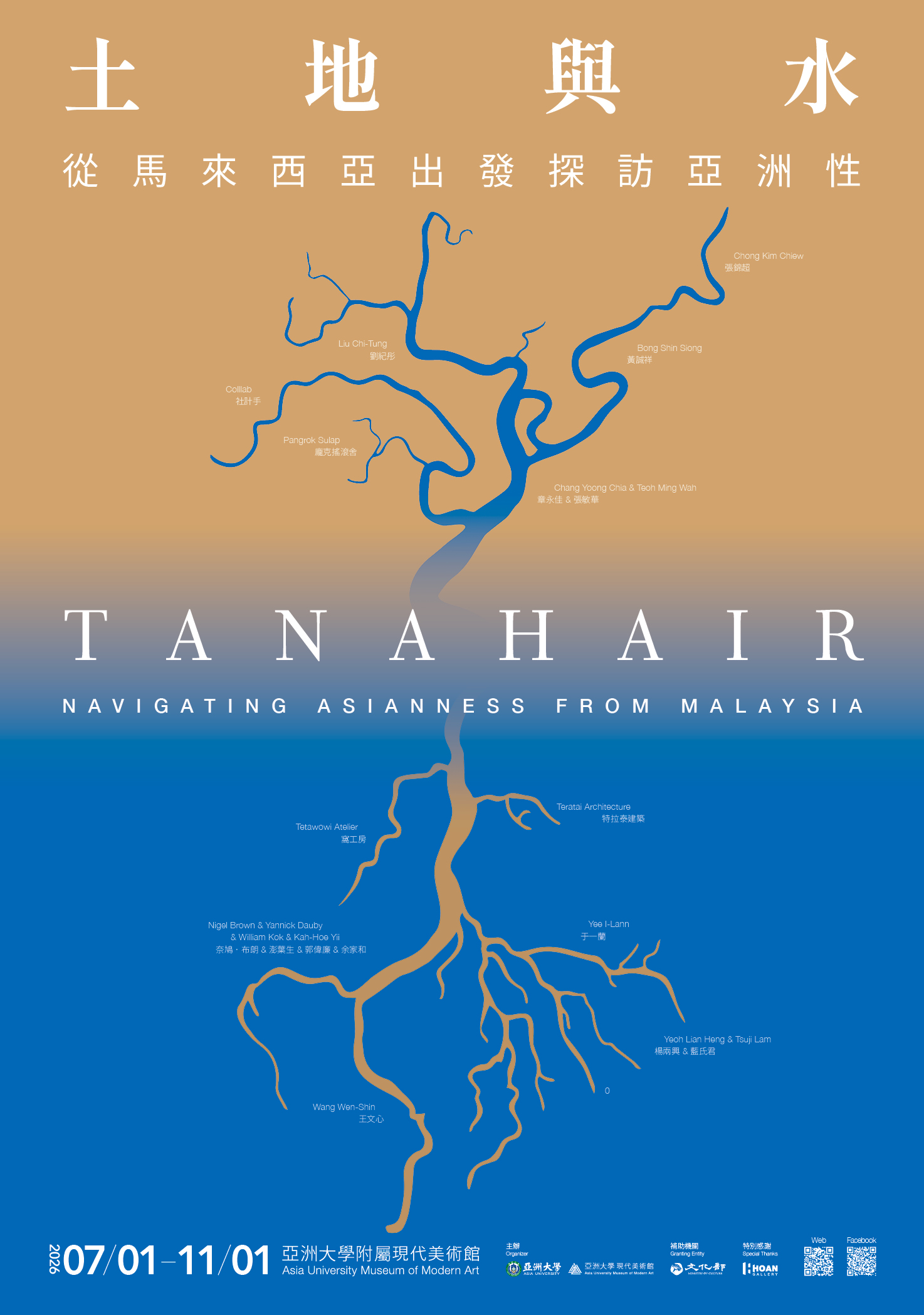
“TANAHAIR: NAVIGATING ASIANNESS FROM MALAYSIA” brings together the works of 13 groups of artists, including 7 groups of Malaysian artists across different generations, 3 architectural collectives that delve into the human-environment relationship via field research and practice, and 3 groups that travelled from Taiwan to West and East Malaysia for residencies. Through mediums of painting, weaving, installation, video, and sound, it probes into the multiple facets of “Asianness.”
Since its founding in 1963, Malaysia has been divided into West Malaysia and East Malaysia. While being distinct in terms of history, culture, and ethnic composition, both regions constitute a complex and dynamic whole. On the historical and cultural dimensions, while sustaining the animistic traditions of the Austronesian and Austroasiatic peoples, Malaysia absorbs the Chinese, Indian, and European cultures as well. Meanwhile, Islam, as the primary religion and a vital cultural framework, continues to negotiate, coexist, and transform along with other cultures, profoundly influencing the national formation, social institutions, and everyday life. Such state of multiple faiths and cultures in juxtaposition renders Malaysia a concrete and dynamic venue to capture Asianness.
“TANAHAIR” as the exhibition theme is a compound word derived from Tanah (earth/land) and Air (water) in the Malay-Indonesian languages. It refers to a concrete geographical reality as well as carries profound cultural and emotional connotations. The term gradually evolved into a vital symbol to connect land, memory, and identity. “TANAHAIR” embodies separate national imaginations across various historical contexts, as its meaning is incessantly reconstructed at the intersection of diverse ethnic groups and colonial histories. It is not merely about the origin but rather points to the relationship persistently generated between the humankind and the environment.
Centering around “flowing” and “rooting,” this exhibition embarks on a journey from the mother rivers of the Klang River in West Malaysia and the Sarawak River in East Malaysia. It explores how land and water connect ecological environments, cultural faiths, and social fabrics, presents humanity’s negotiation process between nature and modernity, as well as reflects on the tangled relationships between land, waters, and identity.
The curatorial team of Land and Water—Teoh Chee Keong, Chai Kit Siang, and Eric Chen.
Participating Artists and Architectural Collectives:
Bong Shin Siong, Chang Yoong Chia & Teoh Ming Wah, COLLLAB, Chong Kim Chiew & 0, Liu Chi-Tung, Pangrok Sulap, Teratai Architecture, Tetawowe Atelier, Wang Wen‑Shin, Nigel Brown & Yannick Dauby & William Kok & Kah-Hoe Yii, Yee I-Lan, Yeoh Lian Heng & Tsuji Lam